The Village That Turned Its Walls Into Art: San Sperate, Sardinia's Open-Air Museum
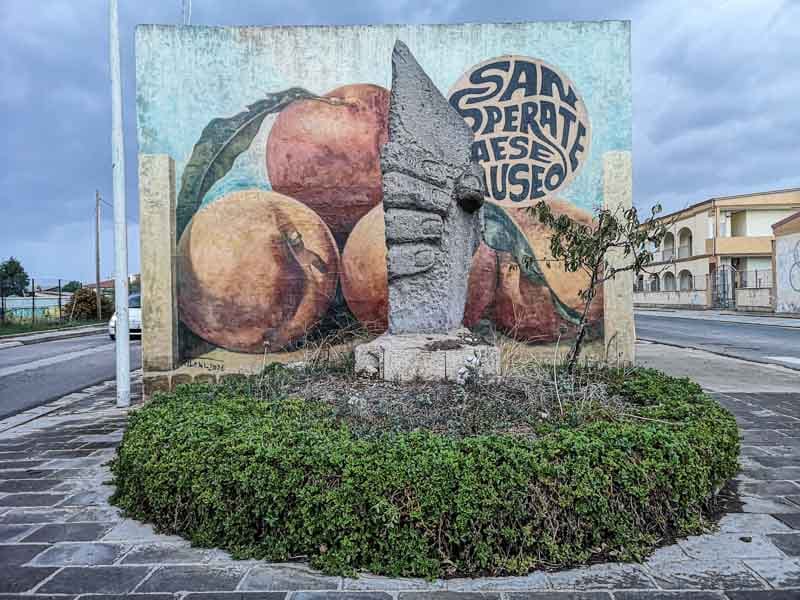
Twenty kilometres from Cagliari, a small village in the Campidano plains has covered every wall, alley, and facade in murals. Here's what it is, how it started, and why it belongs on your list this spring.
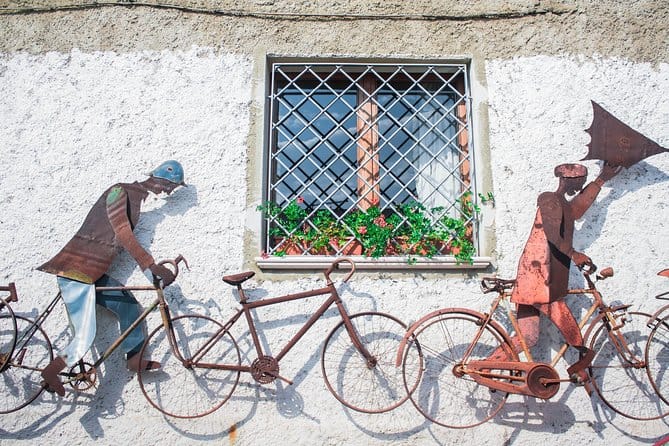
Most people driving through the Campidano plains south of Cagliari would not slow down for San Sperate. It is a small agricultural town of around 8,000 people, unremarkable from the road, surrounded by citrus groves and flat farmland. But step into the historic centre and the effect is immediate: every wall speaks. Every alley turns a corner into a mural. Every blank surface has been claimed by colour, image, and story.
San Sperate is known in Sardinia as a paese museo — a museum-village. It has been accumulating murals since 1966, when a local sculptor named Pinuccio Sciola came back from his travels and began painting the walls of his hometown white, then invited artists to fill them. Today there are over 400 murals covering the streets of the village, the work of local, Italian, and international artists across six decades. It is one of the most sustained and coherent examples of community public art in Europe — and it sits less than 25 minutes by car from Cagliari.
How It Started
Pinuccio Sciola is the reason San Sperate exists as an artistic phenomenon. Born in the village in 1942, Sciola trained as a sculptor and spent years travelling — through Italy, through Europe, eventually to Mexico City, where in 1973 he met David Alfaro Siqueiros, one of the great muralist painters of the twentieth century. The encounter confirmed what Sciola had already begun to believe: that art belonged in the street, on the walls of ordinary buildings, in the spaces where communities actually lived.
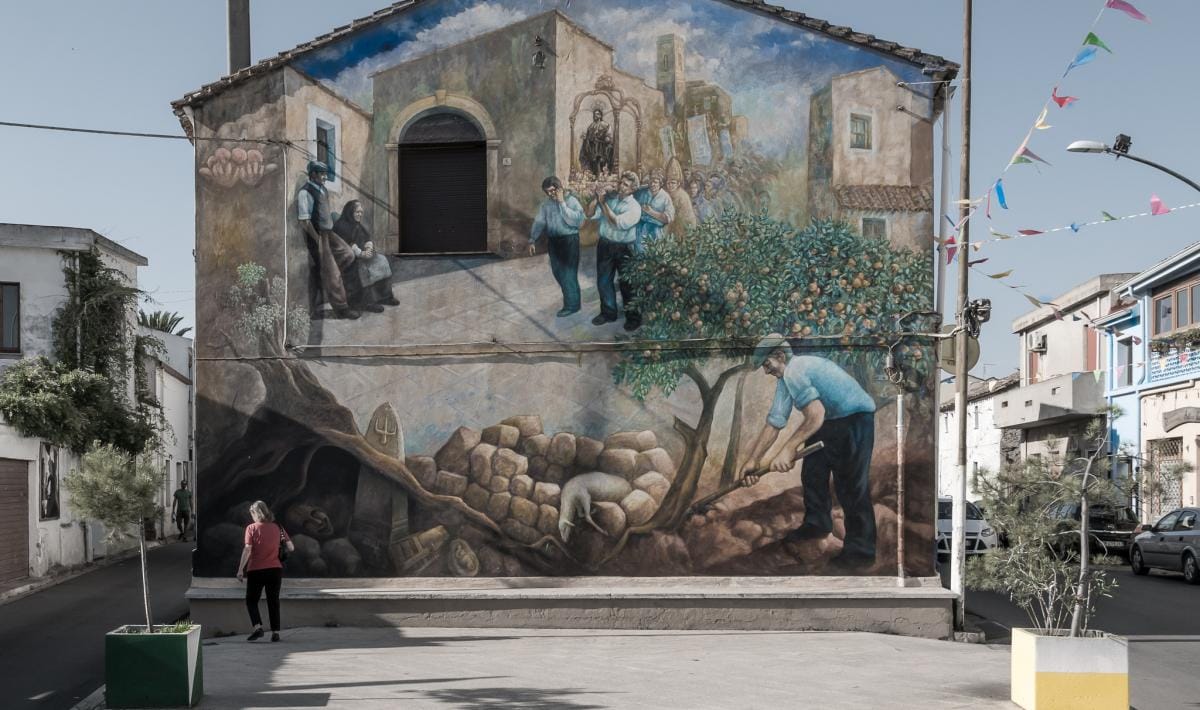
He had started in 1966, on the wave of social protest that was spreading across Italy and Europe. The first murals were painted collectively, with neighbours and local artists, depicting scenes of rural life, the struggles of Sardinian workers, the rhythms of the Campidano countryside. The approach was political in spirit — art as a form of voice for communities that had little institutional representation — but the execution was generous, colourful, and deeply rooted in the specific character of the village.
Over the following decades, Sciola opened San Sperate to artists from across Italy and beyond. The walls kept filling. The style evolved — from social realism to surrealism, from figurative murals to abstract installations, from local folklore to responses to international events. What held it together was never a single aesthetic but a shared commitment to the idea that the village itself was the gallery.
Sciola died in 2016. The project he started is still growing.
What You Find There
Walking through San Sperate is genuinely disorienting in the best possible sense. Around one corner is a meticulous copy of a Piero della Francesca painting. Around the next, a surreal composition of faces overlapping and merging. On a long facade, a scene of the peach harvest that takes place every summer in the orchards just outside town. On a school wall, a mural designed collaboratively with the children inside.
One of the defining pieces of the village is the large Bronze Age mask painted on the gable end of a house near the entrance to the historic centre — a replica of an artifact actually found in San Sperate and now held in Cagliari's National Archaeological Museum. It announces immediately that this is a place where layers of history are worn visibly, without apology.
The Giardino Sonoro — Sciola's garden of sounding stones — is the other essential stop. Set within a citrus grove at the edge of the village, the garden contains dozens of Sciola's sculptures: basalt and limestone megaliths into which the artist cut precise grooves and incisions. When the Mistral blows, which it does reliably in Sardinia, the wind moves through those cuts and the stones sing. It is one of the most unusual sensory experiences in the island — and one of the least known internationally.
Why It Belongs in the Conversation Now
San Sperate is not a new discovery. It has existed for sixty years. It's a place that has been doing serious, sustained cultural work without waiting for anyone to notice.
It is also, simply, an excellent half-day trip from Cagliari. The bus from Piazza Matteotti runs directly to the village centre. There are no entrance fees, no ticketed experiences, no queues. The art is on the walls, in the open air, free to anyone who walks through.
In a year when the world is finally paying attention to Sardinia beyond its coastline — and Lonely Planet specifically cited the island's interior and its cultural authenticity — San Sperate is exactly the kind of place that rewards the visitor who goes looking.
Take the bus. Walk slowly. Let the walls talk.
Sources: Sardegna Turismo (sardegnaturismo.it); Strictly Sardinia (strictlysardinia.com); BLocal Travel (blocal-travel.com); Italy Magazine; Sardinia Magic Experience; Live the World (livetheworld.com); GetYourGuide.