Sardinia Sleeps Under the Stars — And It Does It Beautifully


There is a version of Sardinia that no hotel room can give you. It is the one you find when the tent zipper opens at dawn and the first thing you hear is the sea — a low, rhythmic breath that has been shaping this island for millennia. No air conditioning hum, no minibar, no checkout time. Just light filtering through pine trees and the faint smell of salt and rosemary in the air.
This is camping in Sardinia. And once you have lived it, everything else feels like a compromise.
A Natural Stage Built for the Outdoors
Sardinia is not simply a beautiful island — it is a landscape built, almost deliberately, for outdoor living. The coastline stretches for over 1,800 kilometres, offering an almost endless alternation of granite cliffs, hidden coves, and turquoise bays that rival the Caribbean in colour but retain something far more rare: authenticity. The interior, meanwhile, is a world apart — ancient forests, limestone gorges, and plateaus crossed by shepherds' trails used for centuries before any tourist ever arrived.
With over 129 registered campsites spread across the island, Sardinia has quietly become one of Europe's most compelling destinations for those who prefer canvas over concrete. The infrastructure is there. But nature always remains the real protagonist.
North, South, East, West — Every Coast Is a Story
The north of the island — the Costa Smeralda corridor and the Gallura hinterland — is famous for its granite rock formations and emerald inlets. Camping areas here sit directly on white-sand beaches, offering pitches just metres from the water with views that most five-star hotels would charge a fortune for. The nearby Maddalena Archipelago, a protected national park accessible by ferry, adds another layer of wild beauty for those willing to venture beyond the main island.
Moving south toward the Oristano province, the landscape softens into a more meditative register. The Sinis Peninsula — with its rare white sand dunes, flamingo lagoons, and Phoenician ruins — offers a camping experience that is as culturally rich as it is visually striking. Camping grounds here tend to embrace an eco-conscious, low-impact philosophy that matches the ancient, unhurried spirit of the territory. This is the part of Sardinia that feels like it belongs to another era entirely.
The eastern coast, running from the Gulf of Orosei down toward the southern capes, is consistently rated among the island's most rewarding areas for outdoor stays. Limestone sea caves, paths carved into cliff faces, and crystalline bays accessible only by boat or on foot define this stretch. Camping here means waking up with direct access to trails and water that, outside of summer, you will often have almost entirely to yourself.
More Than a Tent and a Sleeping Bag
The modern camping offer on the island has evolved far beyond the traditional pitch. Today, Sardinia hosts everything from full glamping villages with private lodges and pools to agri-campings nestled among thousand-year-old olive groves and oak forests in the Barbagia heartland. The range is remarkable — and so is the quality.
In the lagoon areas along the west coast, outdoor stays are built around the natural biodiversity of the surroundings. Guests can choose between stand-up paddleboarding on still waters, kitesurfing on open sea, horseback riding through coastal trails, or walking through wetlands that host one of Europe's largest flamingo colonies. It is the kind of place where the daily schedule is shaped entirely by what the landscape offers — and the landscape is consistently generous.
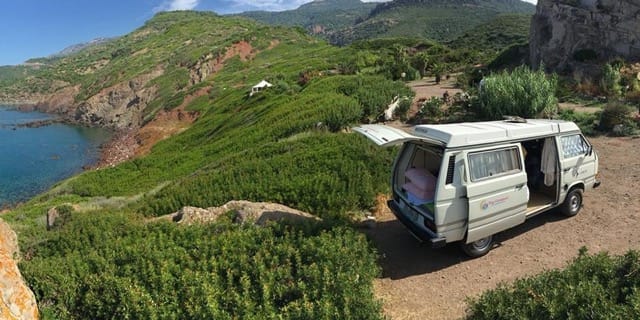
For those arriving with a campervan or 4x4, Sardinia rewards exploration on every level. The road network, while sometimes narrow and winding through the interior mountains, opens up to staggering scenery at every turn. Certain inland and forested areas allow a degree of solitude that is harder and harder to find anywhere else in the Mediterranean.
The Cagliari Gateway
For travellers beginning or ending their Sardinian journey in the south, the greater Cagliari area serves as a natural base. The city itself — with its Phoenician, Roman, Pisan, and Spanish layers stacked across the Castello hill — deserves at least a couple of days before heading into the wild. And when you are ready to leave the urban behind, the southern coastline stretching toward Villasimius and Costa Rei offers some of the most scenically rewarding camping areas on the entire island.
Marine reserves, white dune systems, and sheltered bays with water so clear you can read the seabed from the surface — this southern corridor is a quiet revelation for those who arrive outside of peak season.
Why Now
Spring and early autumn are the ideal seasons for camping in Sardinia. The August crowds have not yet arrived — or have just left — the sea is warm, the light holds longer, and the island feels genuinely accessible. The campsites are open, the trails are clear, and Sardinia, in every sense, is available.
This is not a destination you simply visit. It is one you inhabit, even briefly. And the best way to do that is to sleep where the land meets the sky, with nothing between you and the stars but a thin layer of canvas and the sound of the Sardinian night doing its quiet, ancient thing.
Sources: camping.expert — Campsites in Sardinia, faitasardegna.it: Unique Camping Experiences in Sardinia, senarrubia.com — Camping S'Ena Arrubia outdoor experience, gardensharing.it — Agricamping in Sardinian Nature, pincamp.com / tripadvisor.com — Top Campsites in Sardiniatripadvisor