According to Matter. Meaning and stratification

Until March 30, 2026, the Archaeological Area of Sant'Eulalia in Cagliari opens its doors to Secondo Materia. 'Il significato e la stratificazione' (The Meaning and Stratification) is an exhibition project that combines the works of Maurizio Chiaravalli and Alberto Soi with the curation of Giancarlo Pace. The exhibition, promoted by Mutseu - Sistema Museale Sant'Eulalia, with the support of Terre Ritrovate, Fondazione Giulini, Risorse per il Gerrei, and Regione Autonoma della Sardegna, proposes a unique dialogue between contemporary art and cultural stratification, between material and memory, between present time and traces of the past. The opening is scheduled for Saturday, November 15th at 7:00 pm in the presence of the artists and the curator.
This initiative is part of an exhibition series that started last year with the show 'Viaggio nella spiritualità dell'arte contemporanea' (Journey into the spirituality of contemporary art), which presented a dialogue between the works of Ermenegildo Atzori and Franco d'Aspro set in the fascinating context of the archaeological area of Sant'Eulalia.
During the exhibition period, the products of 'Terre Ritrovate' will also be promoted, a result of a socio-economic project that creatively intersects the history of the territories, the quality of their productions, and culture.
THE EXHIBITION.
Contemporary art, when fully aware of its function, does not just offer objects to contemplate but tools to rethink how meaning is constructed, lost, and reformulated. And it is this critical capacity that characterizes the exhibition at Sant'Eulalia, an archaeological site where architectural, historical, and usage levels overlap. Not just a simple container but an active interlocutor in dialogue with the works, where traces of what was sacred, domestic, or collective emerge from the subsoil of the modern city.
The title, Secondo Materia, suggests a conscious approach: listening to the material, following its trajectories, recognizing its value as an archive of meaning.
Maurizio Chiaravalli, who works with rusted irons, metal meshes, and sheets, transforms forgotten objects into evocative, anthropomorphic presences, witnesses of memories in tension. The material, deprived of its original function, becomes body and sign, evocation rather than representation. His sculptures survive a concluded era and intimately concern us, in their ability to suspend time and meaning.
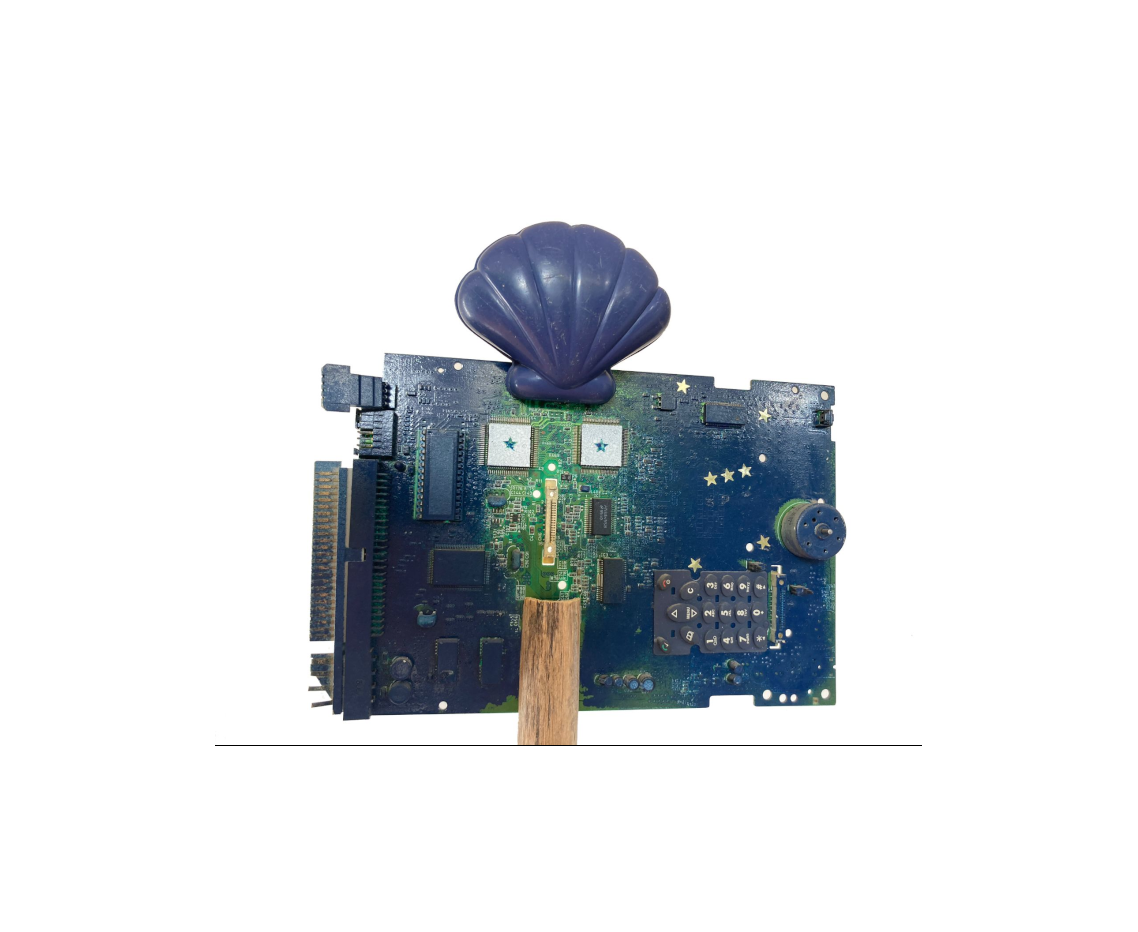
Alberto Soi, on the other hand, approaches the material with a stratigraphic and almost archaeological approach: in series like Futuro Fossile (Fossil Future), animal bones, plant fragments, and electronic components combine in assemblages reminiscent of fossil findings from a technological era now dissolved. Soi does not reconstruct but simulates the discovery, offering a physical and environmental memory where nature and technology coexist as remnants of a time already archived. His works become posthumous testimonies of an era that belongs to us and that we can observe with the detached gaze of an archaeologist.
The comparison between the two artists and the archaeological site is not random but based on methodological consonances: just as archaeology works on the artifact and its decontextualization, Chiaravalli and Soi dig into the meaning and function of the material. Both question what remains, what can still be said when the origin has disappeared. The exhibition thus becomes a device for reflection on time, the value of material, and the cultural stratification that crosses the city.